Thursday, 2 August 2012

Beware the slippery slope!

Hey folks, another brief update on the marriage equality issue that's flared up in Aotearoa recently. I realise this is all running counter to my normal verbose delivery. I guess it just seems like such a simple matter that I shouldn't need to give detailed arguments for why we should stop withholding this basic right from a minority that harms no-one. Instead of making a case for marriage equality, I find I'm spending a lot more time poking holes in the EXTREMELY poor arguments offered against marriage equality. And by far the most popular argument raised is the dreaded Slippery Slope.

The Slippery Slope argument runs like this: If we allow homosexuals to enjoy the same access to marriage rights as heterosexuals enjoy, then we will absolutely and inevitably slide down the slippery slope into allowing marriage to children, and animals, objects, and abstract concepts. Slippery Slope arguments are, prima facie, poor arguments; any student of critical thinking will recognise a Slippery Slope to be a logical fallacy. You will no doubt have already noticed that the slippery slope makes an argument based not upon the facts pertaining to the current case, but rather the prospect of a future case separate to the one being discussed (usually a more extreme, even hyperbolic example, and frequently unrelated!).

Always poor, when applied to issues of rights and fair treatment, Slippery Slope arguments become absurd! The argument here is that extending access to a legal status to include those previously barred on the grounds of their sexual orientation, will somehow lead to a future state of affairs where people can marry children and dogs. The point being missed here is that adults in homosexual relationships are capable of granting informed consent (they can legally enter into contracts), whereas children and animals most certainly cannot! On the 19th of September, 1893, New Zealand became the first modern nation to acknowledge women's right to vote; 119 years later we have yet to extend that right to children, or animals. Yes, 119 years after New Zealand women won the right to vote, we haven't even extended that same right to sheep! Is it conceivable that we could extend this right to children and animals? For a given value of 'conceivable', yes. Does it logically follow that we will? Not even remotely.

Now I suppose the bigoted could cite an example of voting rights in the U.S.A. where the franchise expanded from land-owning white males, to white male citizens, then male citizens including non-whites, then male and female citizens including non-whites, and Native American Indians, etc. However, this completely ignores the fact that in each and every single case, IT WAS RIGHT AND JUST TO RECOGNISE THESE VOTING RIGHTS. It wasn't a 'slippery slope', because each and every time it was the right thing to do. Women were granted the right to vote, not because it was their turn to sample some good old-fashioned freedom pie, but because women are every bit as capable of making a rational and informed decision as men. Even though America's Supreme Court seems to think corporations are people, and consequently they can buy elections, they still don't get to vote in them.

Hence, the only Slippery Slope argument I will entertain, is thus:
Photobucket

Thursday, 26 July 2012

The Tomorrow We Should've Had Yesterday

So, a marriage equality act is to be considered by parliament. The social networks are abuzz with unscientific polling, and even accounting for the younger and more socially liberal demographic found on the hallowed interwebs, the fact that these polls have support for marriage equality outstripping opposition by a margin of about 10-to-1 is quite heartening. It seems, online at least, that people don't really see any problem with consenting adults having their relationship recognised under the same legal category whether these relationships are hetero-or-homosexual. 

However, the debate... those opposed to marriage equality may, according to the polls, be a minority. But BOY are they vocal! Which really makes me wonder.

WHY are they so emotionally invested in the relationships of people they will likely never, ever meet?

Sunday, 15 January 2012

Brevity

Oh right, I have a blog... whoops.

I should perhaps fill this thing with the words and the concepts and the amusing pop-cultural references that are all so hip with the kids these days, but you know how it is. Sit down at the computer, brain brimming with ideas, then NEK MINIT... (see what I did there? Not if you live outside New Zealand I guess).

I WILL write more, and soon, I promise.
But just for now, I'll leave you all with an interesting statistic:
The third most common search term that's lead people to my blog, having made the connection five times, is 'prostitot'

Ifuckinghatehumanitysometimes

Saturday, 1 October 2011

Thus Spoke Tyler Durden

I don't know how I got away with this, but I managed to write a philosophy essay on Fight Club.

Thus Spoke Tyler Durden: Nietzsche through a modern lens

Friedrich Nietzsche believed his ideas were ahead of their time, that he was in truth writing in a world not yet ready to hear the criticism he was levelling at Western culture, a sentiment articulated most clearly in Zarathustra’s Prologue. His philosophy concerned itself primarily with the ‘Death of God’, nihilism, and the possible responses to it. In particular, he warned against the rise of secular utilitarianism, and as a counter-point offered a new ideal to strive for in the shape of the ‘Superman’, or continually evolving ‘over-man’ that seeks to constantly discard itself and become something more. Thematically, Nietzsche’s philosophy is very much one that deals with the nature of human existence and experience, and like Marx before him, acknowledges the influence of historical circumstance on all facets of Western culture, especially the philosophy and science of the Enlightenment. Given his appreciation of historical context, and belief that his work came before the world was ready to acknowledge it, it is worthwhile to compare the works of contemporary scholars and artists, social commentators dealing with contemporary culture, with Nietzsche’s philosophical works to ascertain the relevance of his views to modern society.[1] For such purposes, I believe contrasting Nietzsche’s philosophy as portrayed in Thus Spoke Zarathustra with the novel Fight Club by author Chuck Palahniuk will serve to show that Nietzsche’s ideas are every bit as relevant today as they were in the 1880s, that society at large is still unready to accept his criticism, and also show where Nietzsche himself proved unable to live up to his own ideals.

Before critically evaluating how these two books compare and contrast, it is worth establishing why these two works in particular are suited to such close comparison. The authors themselves, Friedrich Nietzsche and Chuck Palahniuk are both provocative, challenging writers that confront their readers with uncomfortable issues dealt with in a blunt yet compelling manner. Inescapable in all the works of these two writers is the outright contempt they express for the utilitarian herd, the common man personified in Thus Spoke Zarathustra in the form of the Ultimate Man. Both Fight Club and Thus Spoke Zarathustra focus on a prophetic character heralding a new post-nihilist era of human vitality through a process of destruction and creation, tearing down the old order that Nietzsche would consider the ‘Shadows of God’ in order to establish new values and modes to live your life. The structure of Fight Club, in which the unnamed Narrator interacts in concert and in conflict with what is revealed to be his subconscious alter-ego Tyler Durden, in the process destroying his place of residence, his job, and his previously established world view and manifold of values in order to become Tyler Durden, is itself a dramatic portrayal of Nietzsche’s view on how one should comport their life as a process of destruction of one’s old self and appropriation of the world around you to create something new. 

Nietzsche’s Zarathustra is most damning in his opposition to the Ultimate Man, his symbolic representative of secular utilitarianism and the irreligious Christian, characterized as a world-weary, mediocre, enervated man. Throughout Nietzsche’s writings runs this common thread of loathing for the simple, meagre, stupid and altogether common man unwilling to rise above himself, content to work just enough, to pursue pleasure just enough, to rest and live a sheltered, unremarkable life. Those content with mere life and mere health are seen as a perversion and insult to what Nietzsche believes is the only healthy and honest way to live, which is to affirm to the fullest extent an altogether more vital aspect of ‘Life’ and ‘Health’ as driving forces rather than things to be carefully ‘balanced’. It is important to note that Fight Club is situated in a culture informed by, and in fact determined by, a societal change that occurred immediately after Nietzsche’s lifetime that propelled the utilitarian ‘Ultimate Man’ ideal into dominance, namely the rise of the Consumer Society. The ultimate expression of Nietzsche’s Herd Morality, perhaps even his most nightmarish vision come to life, Fight Club exists under the shadow of the utilitarian herd-society where faceless corporations dominate, where space will be explored and exploited by corporate entities and “Every planet will take on the corporate identity of whoever rapes it first... The IBM Stellar Sphere. The Philip Morris Galaxy. Planet Denny’s.”[2] Zarathustra’s warning of the Ultimate Man as being one who takes “A little poison now and then: that makes for agreeable dreams. And a lot of poison at the end, for an agreeable dying.[3] is realized in the Narrator’s situation in Fight Club, an insomniac begging for “little blue Amytal Sodium capsules” and “red-and-blue Tuinal bullet capsules” to help him sleep.[4] The Narrator identifies he is a part of the consumer culture, a slave to the ‘IKEA nesting instinct’, a man who is owned by the very things he owns.[5] Tyler Durden’s aphorisms recited by the followers of his movement proclaim “Advertising has these people chasing cars and clothes they don’t need. Generations have been working in jobs they hate, just so they can buy what they don’t really need.”[6] Very much in line with Zarathustra’s observation that the Ultimate Man works for entertainment,[7] and the concern expressed in Fight Club is certainly relevant and accurate, as the “Magic System” of advertising that causes false needs is much discussed in sociology, for example by Leiss et al. in Social Communication in Advertising: Consumption in the mediated marketplace.[8] Rather than enduring the hardships that will form better character, the people depicted Fight Club exist in denial of the world’s cruelty. The Narrator resorts to guided meditation to distance himself from pain,[9]> the support groups he attends have sanitized names like “Above and Beyond” rather than “Brain Parasites”, and the cancer victims and other sufferers lie about their prospects, claiming to be improving and on the up-and-up.[10]> Concern about the painful or unpleasant aspects of the world is portrayed as an insincere exercise in vanity, with the observation that “maybe Walter’s thinking about a meatless, pain-free potluck he went to last weekend or the ozone of the Earth’s desperate need to stop cruel product testing on animals, but probably he’s not.”[11] The conditions that motivated Nietzsche’s perspective in the late 1800s are even more prominent now in a media-saturated consumer-culture, and are taking on an increasingly grotesque and cruel form, killing through apathy and complacency. Fight Club highlights the darkest aspects of Nietzsche’s belittling and casually belligerent Ultimate Man, most profoundly with the cynical observation of the Narrator’s job as an automobile recall co-ordinator, where death and human suffering is reduced to a simple equation to make it easier for the perpetrators to manage.

Nietzsche’s response to the Ultimate Man was to propose that mankind fix a new goal, that of the Superman. Rather than a fixed state, the ideal of the Superman is a deliberately unattainable point to focus on, investing the value of pursuit of this ideal in the process rather than the destination. The Narrator of Palahniuk’s Fight Club has literally internalized this process of discarding the old personality in order to obtain the new one, perpetually reinventing himself through the destruction of his previous life. Many aphorisms and desperate pleas by the Narrator and his alter-ego reference this theme, particularly the central mantra of Fight Club:
Deliver me from Swedish furniture.
Deliver me from clever art.
May I never be complete.
May I never be content.
May I never be perfect.
Deliver me, Tyler, from being perfect and complete.[12]
Perpetual destruction to make way for a new self and a new world truly defines Tyler Durden throughout the novel, it determines the state the Narrator is trying to achieve. In attempting to become his alter-ego, the Narrator destroys his condominium home with home-made dynamite, abandons his support groups, and assumes a new life as founder of underground ‘fight clubs’. When he has achieved this and becomes complacent of what he has achieved, he blackmails his employers, converts his house into barracks, and begins a social guerrilla movement called Project Mayhem with the fixed goal of breaking society up and tearing it down to make way for a new world order. When he has built his army of ‘space-monkeys’ and is worshipped as a hero, he once more plans to sacrifice the life he has, this time decentralising the movement and attempting to martyr himself with the controlled demolition of the world’s tallest building in order to crush a museum and blast free of the grasp of history. Throughout his continual evolution, constant reference is made to destruction and evolution. “At the time, my life just seemed too complete, and maybe we have to break everything to make something better out of ourselves”[13], “Disaster is a natural part of my evolution... toward tragedy and dissolution. I’m breaking my attachment to physical power and possessions, because only through destroying myself can I discover the greater power of my spirit”[14],”Only after disaster can we be resurrected. It’s only after you’ve lost everything, that you’re free to do anything.”[15] Tyler claims the greatest moment in the Narrator’s life is the point where he inflicts upon himself the greatest physical pain he will ever know with the lye burn, to shock him into acknowledging that he will die some day and to abandon his utilitarian, ‘safe’ preconceptions. To ‘hit bottom’. The most real moment of his life where all that came before and all that will follow is merely a story in comparison. During this process, Tyler details a story of sacrifice that would lead to the discovery of soap, the item synonymous with civilization was discovered through human sacrifice, and without human sacrifice we would have nothing.[16] The Narrator’s/Tyler’s plan to create a new world, is to shock people out of complacency and the herd mentality, to confront people with challenges to awaken in them the will to fight and the sense of power and possibility they possess if only they are willing to suffer and sacrifice. The Project Mayhem homework assignment to provoke fights with strangers in order to show them their power and fighting spirit, and awaken them from the utilitarian malaise, is a more direct and physical version of Nietzsche’s fondness of provoking people intellectually to shock them into a desire to engage with their beliefs and assumptions critically and consider alternative perspectives. This is even more forcefully achieved through the process known in the novel as ‘Human Sacrifice’, where members of the Assault Committee of Project Mayhem seek out individuals representative of the ‘minimum-wage slave’ and hold them at gunpoint, taking their drivers license and leaving them the ultimatum that if they aren’t well on their way to realizing their dreams within a given period, the gunman will return and kill them. This is a far more forceful and external practice than Nietzsche’s urging to follow a personal philosophy of health and evolution.

There are obvious parallels between Fight Club and Thus Spoke Zarathustra, and Tyler Durden is certainly a modern representation of the creation of an idealized Superman/Overman for one to pursue, but there is still a great deal of difference between the vision portrayed by Palahniuk, and the ideal Zarathustra claims to herald. Tyler Durden is a far more externally-active agent than Nietzsche’s inwardly-focussed Superman. In essence Tyler is more a social activist than a process of personal development. More striking, however, is the fact that although clever and capable, Durden is far less refined than Nietzsche’s Superman drive. Nietzsche strongly supported the ‘noble’ ideal, that he referred to as the ‘Master’ morality, which he described as loving tradition and despising the new, an opinion completely contrasted by Durden’s plan to destroy a national museum because “This is our world, now, our world, and those ancient people are dead.” In this perhaps it can be seen that Nietzsche could not surmount his own desire to hold onto tradition and relinquish history to the flux and flow of time; that he is weak in clinging desperately to history and attempting to fix it solidly when it should be allowed to be destroyed, sacrifice it to affirm the changing world. Even so, the Narrator’s motivation in creating Tyler Durden is a desire to be noticed, to no longer be ‘God’s middle children’.[17] Tyler Durden exists not to embrace the freedom of a post-nihilistic world where God is dead and buried, but to act out in petulant anger to force God to take him back. Not only is the creation of Tyler an attempt to gain God’s notice, the Narrator is unable to continually sacrifice himself and become his alter-ego. In Tyler’s final act, he subconsciously sabotages his attempted martyrdom.[18]

Ultimately, the novel Fight Club is a modern exploration of someone struggling to live up to Nietzsche’s ideal of the Superman, unable to escape the herd society that Nietzsche warned us against. Far from a perfect example of perpetual self-overcoming, this book highlights the difficulties involved in attempting to live your life in pursuit of the Superman, emphasising that it will never be a complete process, that it is one doomed to failure, and that that very failure is perhaps the purpose itself. As we are told in the Narrator’s recollection of the very first time he ‘meets’ Tyler Durden:
One minute was enough, Tyler said, a person had to work hard for it, but a minute of perfection was worth the effort. A moment was the most you could ever expect from perfection.
Nietzsche was naturally suspicious of universal truths, and perhaps set an impossible goal because a useful lie is enough.


[1] The subtitle of Beyond Good and Evil, “Prelude to a Philosophy of the Future”, simply begs us to consider Nietzsche’s philosophy in the context of the times we now live in, to see how well his assumption has held up!
[2] Chuck Palahniuk, Fight Club, Adelaide, 1997, p.171.
[3] Friedrich Nietzsche, Thus Spoke Zarathustra, Trans. Graham Parkes, New York, 2005, p.16.
[4] Palahniuk, p.19.
[5] Palahniuk, pp.43-44
[6] Palahniuk, p.149
[7] Nietzsche, p.16
[8] Leiss et al., ‘Advertising in the Transition From Industrial to Consumer Society’, Social Communication in Advertising: Consumption in the mediated marketplace, London, N.Y., 2005, pp.83-87.
[9] Palahniuk, p.75.
[10] Palahniuk, pp.34-35
[11] Palahniuk, p.55.
[12] Palahniuk, p.46.
[13] Palahniuk, p.52.
[14] Palahniuk, p.110.
[15] Palahniuk, p.70.
[16] Palahniuk, pp.151-152
[17] Palahniuk, pp.140-142
[18] Palahniuk, p.205

Tuesday, 17 May 2011

Islamic Invasion - Too long for Facebook

Ehhhhhhhhhhh, I got drawn in again. The facebook curse, someone makes a passing remark, and I respond with an essay. Facebook status updates are not the venue for lengthy diatribes, so here is a snapshot of my quickly-typed opinions regarding Islamic migration, cultural exchange, and national identity. Consider this more conversational than academic.
And forgive the formatting, Facebook is not an ideal platform.


I personally have no problem with the Burqa, it's not too dissimilar to your average slob dressed in baggy jeans and a baggy hoodie with nowt but a fag-end showing (although there could presumably be an attractive person underneath the burqa, and my inner pervert gently weeps), I only have a problem with coercion. And there's no guarantee that someone wearing a burqa is forced to do so *against* their wishes. It's a cultural garment, and so long as it is worn voluntarily, then what business is it of ours to tell someone else how they may dress? In any case, generational exposure to a new society with new norms will have successive generations appearing more and more Ocker (Allah help them =P) and the issue will resolve itself UNLESS the point is forced, in which case the burqa will no doubt remain as an emblem of identity and continuity with a culture where those being targetted actually felt accepted.
For purposes of identification etc. on private property (ie. banks) then this is not an issue of law, but rather an issue of the rights of owners of private property to enforce a sensible dress-code, as such locations are within the private sphere, NOT public, and as such it is unnecessary for legislation to be enacted. France, take note.

Whenever Sharia Law is brought up, it feels like a smokescreen or xenophobic knee-jerk reaction to (heaven forbid!) something different! Cultures from regions heavily populated by Muslims are not a mainstream thing in most western nations, so the debate in the public sphere carries the burden of representation for Muslims, and the quiet moderates who live down the road, tend their garden, follow the footy and enjoy a good halal barbecue aren't sensational enough to grab headlines... "In the news today, Muslim Couple Perfectly Normal, had Lamb Roast on Sunday, Concerned with the Rising Cost of Petrol, settled in to watch Australian Idol... here's Tom with the weather!"
Doesn't really happen, does it? Folks point at terrorists and poorly researched polls (like the one in England that asked the leading question "do you see yourself as British, or Muslim?"... the number of 'Muslim' responses shocked folks who didn't really stop to consider what the result would've been if Christians were asked if they saw themselves as British or rather as Christian), at demogogues and rallies, at violent protests in war-zones and so on, and treat that as representative.
Every time some makes a fuss about the "Sharia law" strawman, it paints the entire collective of so, so many differnet cultures and ethnicities, religious sects and persuasions, with one oriental, alien 'other' brush, the binary opposition at play.
I'm curious as to what spurred your initial post? Most Muslims don't want Sharia Law, no non-Muslim is going to settle for life under Sharia law, and within the grand sweep of Islam there are so very many interpretations of Sharia anyway that it's near meaningless to implement. Honestly, the only religion likely to take hold of Australian law to the detriment of society is Christianity. The moralizing busy-bodies have already afforded fictional people the rights of legal protection from rape or sexual misconduct, that's far more of a worry than the spectre of Sharia Law.

And as for 'becoming Australian', or in my case, becoming a Kiwi, this shouldn't mean discarding your prior cultural identity to conform to some homogenous fiction of national character. People should be themselves, provided they obey the laws as is the social contract, the understanding that you will enjoy the benefits of society provided you abide by the rules and conditions for participation, or else your ability to participate (freedom) will be curtailed.
There's always such concern that foreigners will undermine national values, national culture... this idea that values and culture are static, timeless and universal is complete bullshit. A culture that does not grow and evolve, is dead. And those values we hold dear, we must have faith that they will endure and will influence those who encounter our culture, and those values that do not survive contact, deserve to be lost as they are weak and undesirable values. A point the Americans got right in claiming "We hold these truths to be self-evident", a good idea is a good idea and when we consider things on their own merit rather than basing our judgement on who puts the idea forward, value will show. The only thing that will ensure that bad values prevail is adhering to a binary us-vs-them mentality, tribal mentality, that will not admit to honest analysis and criticism, treating association and exclusivity as more important than robust, rational debate on what is and what ought to be.

If anyone is still awake after reading all that, I commend your steely determination, and denounce your sense of masochism!

Friday, 25 March 2011

Stand up for what you don't believe in!

So, it's 'A' Week on Facebook, and as everybody knows, nothing truly happens unless it happens on Facebook.
Anyone that really knows me, undoubtedly knows that I am an atheist, and is probably peripherally aware that I take a keen interest in culture, identity and ideology, especially as regards religion and religious thought (not to mention considering the philosophy of theistic beliefs, and metaphysics and ethics which are most commonly espoused as part of religious belief). Consequently, I've decided to acknowledge 'A' Week by detailing why I am an atheist. Not exhaustively, of course, none of us have the time or will to endure that!

Why I am an atheist:
I haven't found evidence of the existence of God
I cannot trust my reasons for wanting God to exist
I do not need God to exist for my life to be good
Post-Script - Why do I have to prove it?

I have a few issues with the question "Why are you an atheist?", and these will be dealt with in a post-script essay. Leaving that aside, I can turn to considering my beliefs, which is useful even if I don't bear the burden of proof. After all, I wasn't asking whether or not I'm right, but rather why I myself am an atheist, which falls in the realm of value-judgement.

Why I do not believe in the existence of God:
Not for want of trying!
As a kid I attended church groups, bible classes and Boy's Brigade (like Scouts but without the badass survivalist element). God's existence was granted uncritically in all these activities. But I don't believe in God. If any of that was supposed to convince me that God exists, something went wrong.
As an adult, I'm interested in the arguments for the existence of God, and thus far I remain unconvinced that God exists. I grant that God could exist, but I do not grant that God does exist. I cannot responsibly make that claim as I cannot prove it; even if I believed it and even if the belief panned out to be true, I cannot justify it therefore I do not know it.

The Ontological argument that God exists by definition is considered fairly dodgy, insofar as honest reasoning goes (despite being able to be explained to the tune of Waltzing Matilda, or perhaps because it can be explained to the tune of that famous Aussie epic... you know they're all descended from convicts, can't trust 'em!).The argument goes that basically, God is defined as being "that than which nothing greater can be conceived", and if we consider something that is absolutely perfect in every way, yet lacks existence, then we can think of something greater simply by adding 'existence' to the mix. Therefore God, being that than which nothing greater can be conceived, necessarily exists. Pretty dodgy, right? Particularly because it assumes that 'existence' is an attribute that something may either possess, or lack. The problem is that means there exists things which do not exist. This all gets extremely messy, so look it up on Wikipedia, or write a comment below this article!

Cosmological and Teleological arguments have a bit more grounding in demonstrable fact and rely much less on logical trickery. However, where they fall down is transitioning from the uncertainty of existence itself to certainty in the existence of God: "Hey, isn't it amazing that the universe is so perfectly balanced to allow life, and that there's a universe in the first place! Ipso facto; God". Needless to say, this leap of faith is unconvincing. You'd think that Darwin would've put paid to Teleological arguments by showing that the appearance of design needs no designer, but we have modern day Paleys arguing for design in the Hot New Science (in Paley's day, biology/genetics was de rigueur, whereas today astrophysics gets all the girls... just ask Neil deGrasse Tyson, that magnificent hunk of intellect! What with his dreamy bow-ties and deep appreciation for the responsible pursuit of knowledge... oh dear, I find myself in the throes of a mancrush). The arguments run that the universe is so finely balanced that there must be some controlling force, some designer, to set it as such (in the Teleological case), or that the universe requires a first cause to have created it (Cosmological). Even if we are to grant these considerations, and there's a lot to be said for and against these arguments (boy is there ever!), it is a leap to say the least, to claim that these forces must be some divine personal agent! I suspect that this is so attractive because we spend so much of our lives thinking empathetically, in terms of propositional attitudes, that we see intentionality where there is none. Just like the humble puddle that marvels at how the pothole it occupies is perfectly suited to fit it, and how fortunate it is that God has created a pothole to so perfectly suit this humble , unworthy god-fearing puddle.


Second Point - I'm suspicious of my own desires and thoughts
In other words, I'm sceptical.

I personally believe that we should be most vigilant in regards to the things we most want to be true, in order to counter personal bias.
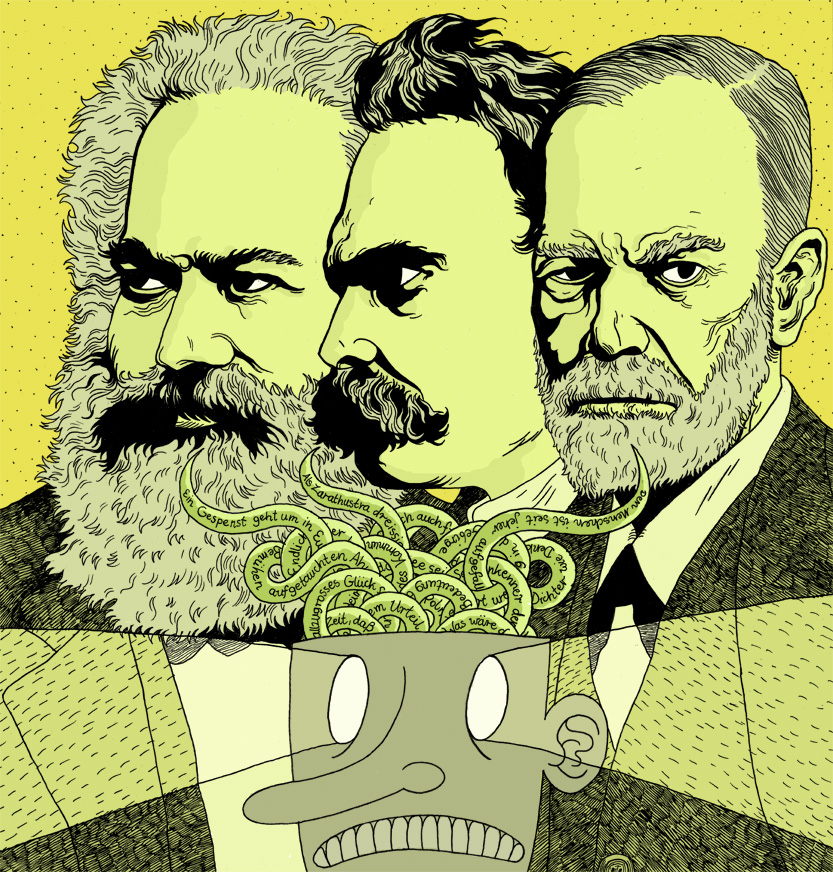
As such, I'm naturally suspicious of the claims of religion. Who doesn't want more than some 80 odd years to live? What's not to love about some divine cosmic agent ensuring that justice will always be served? (convenient how we only tend to think about justice when we feel wronged, all those times fortune smiles on us to the cost of others tend to get overlooked...) And who wouldn't want the power to alter reality by closing your eyes and asking it to change? Yeah, that cancer you don't really like? Gone, just like that. Where do I sign up? But, I'm suspicious of the Just World Fallacy clause that God ensures that justice will be served, we have no proof of an afterlife (or of souls, fun topic), and prayer seems completely useless if God really does have a plan (if there's a pre-destined plan then why would God change it if you ask Him to?). The philosophical Masters of Suspicion make a few good points about the psychology of religion: Freud explains God as a comforting universal Father figure that will never abandon us (this is amusingly flipped in Fight Club), Marx explains God as our idealized projection of Humanity, and Nietzsche argues religion itself was originally a tool of passive resistance to overthrow the order of more honest tyrants, tricking them into submission. It's not perfect, but it is interesting to consider!

Consider also that our brains are highly developed and VERY good at tricking us. We have elevated pattern recognition to art, literally! As such, we tend to see significance where there is none, patterns that do not actually exist, and even extend intentionality to inanimate objects (like that bastard of a chair that keeps hurting my little toe!). We think of five dice showing '6' as more significant and rarer than five dice showing '1, 2, 2, 4, 6' (unless you're playing Yahtzee with my sister, that cheat), where there's statistically no difference whatsoever between the two throws, in the same way we see combinations of events as more significant. We think in terms of cause and effect, linking unrelated events, seeing intentionality in things/events that lack agency, and think anthropomorphically, identifying human attributes in non-human things. Keep this in mind when considering the concept of God's divine will, where it's claimed that God has a plan that is partially explicable, we can see his will and reason in certain combinations of events... yet when this consistency used to prove God's existence runs afoul of inconsistency, we're told that God's will is mysterious and unknowable... is it not more reasonable to assume that we are fallible and are projecting a connection, a pattern, on events that are in fact distinct? Likewise, we readily see God's will in our surviving the earthquake, yet peculiarly not in sending the life-threatening earthquake to begin with.

Third Point - I don't need God
Here's the big point about 'A' Week: It's not about proving that God doesn't exist, theists are perfectly entitled to their beliefs (and beliefs espoused in the public sphere can be debated on their merits in a charitable and fair-minded spirit). It's about the belief that it's okay to be an atheist (agnostic or otherwise). This section deals with why I'm perfectly comfortable, perfectly happy, to be an atheist.
I don't need God to be a good person, nor do I need God in order to appreciate a fulfilling life.

Ethics: Turn to the letters page of your local/national newspaper of choice, and you'll no doubt see, from time to time, the claim that your nation was founded on Christian values. God knows Garth George bangs on about it in the New Zealand Herald. If our history is anything to go by, our nation was founded particularly on those Christian values of 'Imperialism' and 'failure to live up to the contractual obligations of our founding document', but I suspect these aren't the values the letter writers wish to highlight...
The thing is, just because Christians espouse these values, does not mean they are Christian values. Not exclusively, not as originating with Christianity. Virtue ethics has been around in Western thought since the 4th century BCE, consideration of what is 'right' and what is 'wrong' has existed for as long as there has been social interaction, and the principles of charity/compassion/etc. have been part of social thought long before the Romans decided to violently suppress an upstart Jewish cult of personality. Concepts of virtue exist regardless of whether or not Christianity exists, you do not need God to be compassionate/charitable/honest/trustworthy/hard-working/anything else Christians consider 'good'.
Is it possible to be moral or ethical without God? Consider this for a minute: If virtue loses its value without God, was it really virtue that held value in the first place? If virtue lacks value without God, virtue was worthless to begin with, in which case the argument that we need God for the sake of having a virtuous society is bunk, as there is no innate worth in a virtuous society. Any system that loses its ethical force with the loss of its divine agent, is not an ethical system.
I can be good, because ethical virtue exists independently of God.

A life worth living: Here's where I tend to get passionate, because I cannot fathom living as if this life is merely a test, a dummy run, something to be endured for the sake of some mysterious afterlife. How can this life be meaningful or valuable if it is to serve only as a vale of tears for the sole purpose of creating a robust soul?
There are people who disparage the world we live in. Who insist that beauty can only be found in a Kincaid Painting life with what someone awesome described to me as 'Nordic Jesus' teaching kids to feed birds, where invisible angels are the only thing that make the world beautiful, that sunsets are beautiful only because God made them, where a garden cannot be enchanting if there are no fairies at the bottom of it. I know this to be true, I've seen enough poorly animated emails to burn that bullshit shimmering snowfall permanently into the back of my skull! I cannot see the world this way, I cannot say a pohutukawa tree is beautiful only because God made it; it is beautiful because I can see beauty in it! My world is meaningful and precious without God, without an afterlife, I could not possibly neglect this unshakable fact of my existence that it is a very, very good thing to be alive in a world of joy and sorrow, pleasure and pain, meaning and whimsy and all.
Life is beautiful. The world is beautiful. Even the ugly bits, especially the imperfect bits, who could love a perfect world? To be alive, to exist, is an immeasurable blessing simply because it is so improbable, fleeting and fragile. Life is that much more precious knowing that I will die, that others die, and believing that is the end. What matters is not what comes after, but what we do while we're here.
"I believe the cost of life is Death and we will all pay that in full. Everything else should be a gift. We paid the cover charge of life, we were born."
-Bill Hicks, February 1988

Happy 'A' Week, and if you're so inclined, God bless you. I will not judge you the poorer for it =)


P.S.

Warning: This simply deals with the question, and is unnecessary to read. Feel free to ignore!
Before I give an answer, it might pay to examine the question, lest we run the risk of dedicating lifetimes to the pursuit of an answer that turns out to be something as meaningless as 42 without the benefit of a precise and comprehensive question that would render the answer explicable. I guess in that case we could recoup our losses by releasing an autobiographical novel about the whole ordeal, or at least the thrilling climax where we obtain the final question with a flashback about how the answer itself was obtained. Perhaps with a spin-off or two, maybe a movie. But I'm sure you'll agree this is hardly the most efficient and direct way to go about things!

For convenience, I'll operate on the assumption that we're dealing with Abrahamic Monotheism as the counterpoint to Atheism, as that's what most of us will be most familiar with. It also tidies up my next point by virtue of giving me one name to work with:
There's two general ways to look at the question "Why are you an atheist?", which are essentially "Why do you not believe in the existence of God", the approach where the existence of God is assumed, and "Why have you developed no theistic beliefs?", that does not claim any existence of God, or to put it another way, asks only about the presence or lack of beliefs without dealing with the content of such beliefs.
"Why do you not believe in God" posits the existence of a God to disbelieve in. This becomes problematic if we elaborate slightly to ask "Why do you believe God does not exist?", which isn't strictly the same question but has enough general equivalence to be commonly taken as the same thing. In this case the question suggests there is a God, that the target of the question believes does not exist, and as such is somewhat of a leading question. This is a no-no in critical thought, as it has to grant the counter-point or the content of it (that there is a God) in order to answer or respond to it. It also assumes, to a degree, that belief in God is natural, the baseline assumption from which to operate.
The other way of seeing it, to ask why one has not developed theistic beliefs, says nothing about the content of said beliefs, but does assume that believers arrive at their beliefs rather than being born with them. This may be controversial to believers, I'm certain at least some denominations hold that belief in God is innate and that it is merely a failing or a wilful rebellion that forces one to claim disbelief, but I don't think this really holds true of believers. If theistic beliefs were innate (and inerrant, oh-ho!), surely there would be no need for instruction, you would not have to teach children about God, religion, etc. There are counterpoints to this argument of course, but for the sake of brevity I'll assume that people begin from a tabula rasa state, with little more than the building block essentials of a Kantian manifold of sensations from which to construct their conscious minds (I'm name-dropping the Transcendental Aesthetic to show how smart I am, and to justify having sat through the impenetrable density of Immanuel Kant's meticulous drudgery).

Shall we look at the Burden of Proof? If so "Why do you not believe in God/Why are you an atheist?" is the wrong question to ask, as it makes the claim that there is a God which must be disproven, where God is yet to be proven. This isn't merely making others do my work for me, it's a simple operating principle of critical thought: It is harder to exhaustively disprove something than it is to prove something, therefore the burden of proof rests upon the positive claim until such time as it has reasonable grounds for belief, in which case the burden of proof is discharged to the counter-claim. Look at it this way: Have you ever read a Where's Wally book? ("Where's Waldo" in its original American, they translated it into English for us here in NZ, I shall use 'Waldo' henceforth) Taking any given picture, one could claim "This picture contains Waldo", or "This picture does NOT contain Waldo". Now, to prove the picture contains Waldo, you need only point at Waldo, which is easy enough to do once you know where he is. To prove the picture does not contain Waldo, you must meticulously, laboriously and exhaustively point to every single part of the picture where Waldo could conceivably be, every possible point of evidence, and show conclusively and comprehensively that he is not present at any such position. I know finding Waldo is hard sometimes, because he's a jerk (and probably a hipster) who likes to hang out with others dressed almost identically to himself, but the key point to recall here is that once you find Waldo, you can stop looking! In order to prove he doesn't exist, you MUST look EVERYWHERE.
The same thing applies to God. Conceivably, it should be easier to prove the existence of God than it is to exhaustively disprove the existence of God, and as such the burden of proof is on those claiming the existence of God. This is why I assume the 'lectures' organised by the Christian group StudentLife at the University of Auckland, that begin by asking "Has science disproved the existence of God?", are complete bullshit. Simply because they don't even understand the question they're trying to answer. This is why atheists who can articulate their position clearly usually do so not by saying God 'does not exist/cannot exist', but rather by claiming 'there is insufficient evidence to support the claim that God exists'
Putting this back into the original context: The question shouldn't be "Why do atheists not believe in God" but rather "Why shouldn't atheists not believe in God?"

Thursday, 3 March 2011

The Diary of Professor Kovacs

Kovacs' journal, February 28th, 2011. :
Discarded pie in Quad this morning, Doc Martin tread on soggy pastry. This campus is afraid of me. I have seen the admission letters.

Bodies block the stairwells as corpses clog sewers, effluent backing up InfoCommons toilets, ruining sneakers.

Whores and sodomites preen like peacocks, oversized glasses and skinny jeans. Anime lolitas, grown-up prostitots.

Cockroaches huddle in high school cliques, deer in headlights, hiding behind bravado and ignorance. Arts students could have been saved, could have learned trades, like my father, worked way out of struggle street like Prime Minister Key. Instead they follow the dronings of lectures and communists, and didn't realize that the trail leads to Burger King until it's too late.
There's conjoint degrees, don't tell me they didn't have a choice.

Young Labour, Amnesty on Campus, Greens, AUSA, feminists and queers. The communists are everywhere.
Children proud to sit in Shadows, all afternoon. Their vice is idleness, the youth are weak, grain liquor in the morning is cereal.

Like herds of demented cows, stood in thoroughfares, pressed up against lecture theatre doors, there is no escape. Invest in electrified cattle prod, ask Dr. Dreiburg to procure one. He has the time, he has tenure.
Students, the best and brightest of the future, too stupid to learn which part of the toilet to piss on.

InfoCommons, library computers, full of students using Facebook. Always talking, saying nothing.

No compromise. The theatre, full of students looking down at me, crying "Grade us!"
I stare back and whisper, "D"